Construction Drone Visits: A Worked Budget Worksheet
Compare six planned construction visits using declared example costs, reporting scope and cost per usable report. Includes an editable worksheet.
Start with the reporting requirement
A recurring drone budget should explain what each visit must deliver. Six flights are not automatically six useful reports. A capture can miss a work front, occur before the milestone, or produce material that needs extra editing. Define the reporting unit before comparing a series of one-off visits with a recurring agreement.
This worked example uses invented planning inputs to show the arithmetic. The amounts are not SkyViews rates, market benchmarks or an offer. Replace them with written project quotes. The model assumes one report per planned visit and excludes tax; use a consistent tax basis throughout your own comparison.
A six-visit example
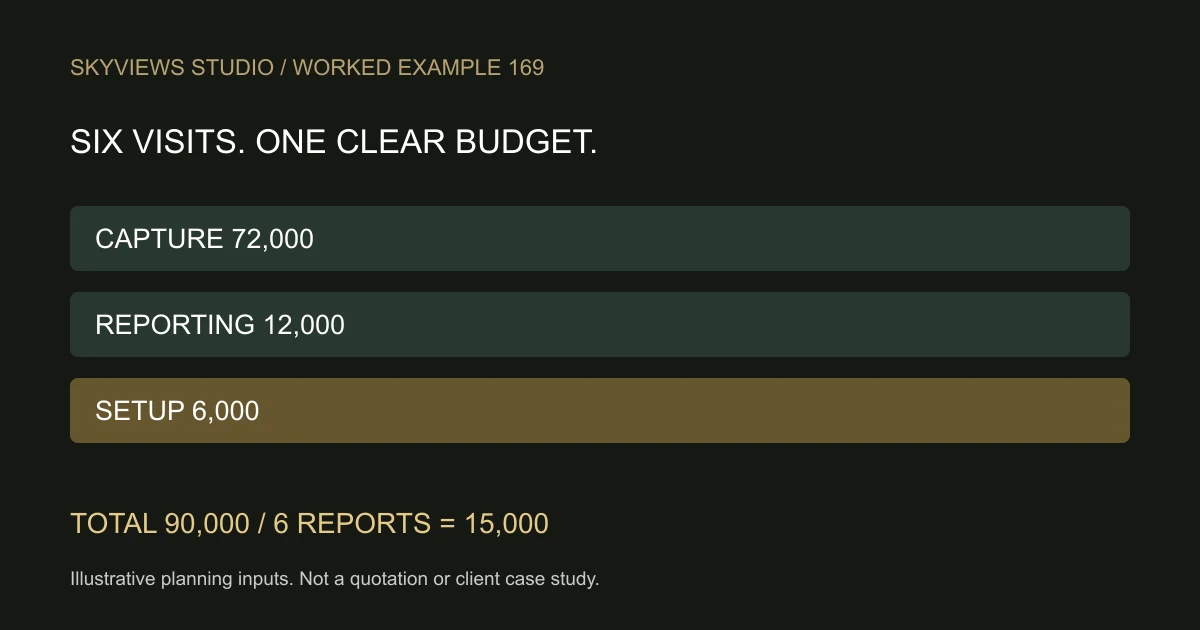
Assume a construction team wants six monthly image sets and a short annotated report after each visit. It budgets ₹12,000 per visit for capture, ₹2,000 per visit for reporting and ₹6,000 once for setup. Setup means agreeing viewpoint names, the folder structure and the first reporting template; it is a planning allowance, not a statement of how any supplier charges.
| Budget line | Calculation | Example amount |
|---|---|---|
| Capture | 6 × ₹12,000 | ₹72,000 |
| Reporting | 6 × ₹2,000 | ₹12,000 |
| Setup | One allowance | ₹6,000 |
| Total | Capture + reporting + setup | ₹90,000 |
If all six reports are usable, the allocated cost is ₹15,000 per report. If only five are usable and the costs remain unchanged, it is ₹18,000. If no report is usable, cost per usable report is undefined: it is not zero. The worksheet below makes that distinction explicit.
Compare equivalent scopes
Suppose six independent visits are quoted at ₹16,000 each, including equivalent reporting and setup. Their total is ₹96,000. The example recurring scope is ₹6,000 lower, but that difference is meaningful only if both proposals cover the same locations, outputs, revisions and access assumptions.
Do not compare the ₹12,000 capture line with the all-inclusive ₹16,000 visit price. That would omit reporting and setup from one side. Similarly, a lower annual commitment can be poor value if the work programme changes and unused visits cannot be moved. Ask for the rescheduling, cancellation and unused-visit terms in writing.
Record the assumptions that change the result
- Visit count: Match visits to actual review dates, not simply the number of calendar months.
- Travel and access: Identify repeated travel charges, waiting-time rules and the site contact.
- Deliverables: Name the photo count or selection process, annotations, edit formats and review round.
- Comparability: Agree viewpoint labels and record any change caused by access or site conditions.
- Exceptions: State how an incomplete capture, weather interruption or changed brief affects cost and delivery.
Treat contingency as a separate allowance with a stated reason. Do not quietly count it as supplier profit or assume it must be spent. Taxes and payment timing should be checked against the actual proposal by the person responsible for procurement.
Use the worksheet in a scope meeting
Enter the quoted visit and reporting amounts, then change the expected usable-report count to test the consequence of a missing report. This is a sensitivity exercise, not a forecast that a visit will fail. Write the assumptions beside the result and keep the proposal version used for the comparison.
The calculation does not establish that flight is feasible or that imagery can certify completed quantities. A site and operational review is still needed. Start with the construction documentation service, then compare the project scope options and share the site, dates and reporting audience through contact.
Plan your project
Share your site, dates and intended output so we can confirm a suitable scope.
Construction & Infrastructure · Compare project scope · Get in touch
Related reading
- Recurring Drone Service Retainer Planning in India: Scope and Reporting Guide
- Owning a Drone or Hiring a Crew: A Worked Cost Model
- Compare Two Drone Quotes: A Worked Scope Example
Contact SkyViews Aerial Drone Studio at +91 90190 56479 or skyviewsdronestudio@gmail.com. Service area: Bangalore, Karnataka and India and wider Bangalore, Karnataka and India.