Drone Cinematography for Feature Films & Movies: Directors Guide India
A comprehensive cinema production guide for directors, DOPs, and line producers integrating full-frame aerial cinema, anamorphic lenses,...
By SkyViews Aerial Drone Studio Cinema Production Team · Published
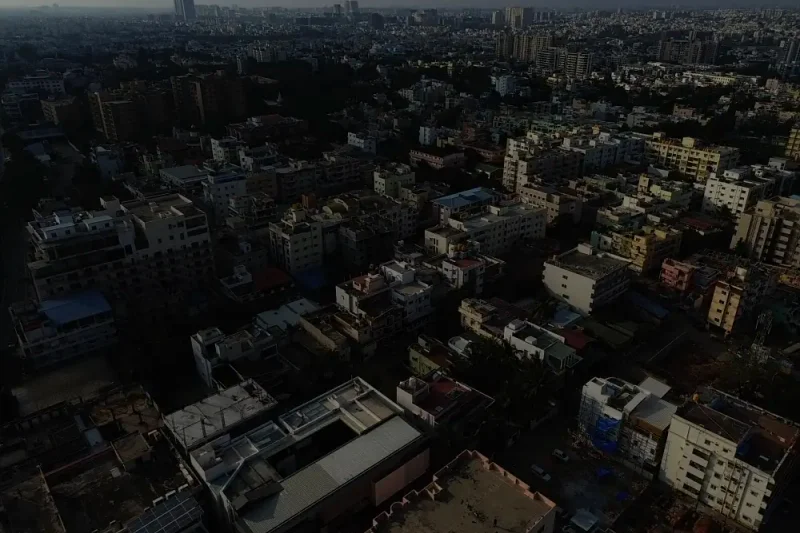
Aerial cinematography in Indian cinema has evolved far beyond novelty establishing shots. Modern feature films, regional blockbusters across Sandalwood, Tollywood, and Bollywood, and flagship OTT series for Netflix, Amazon Prime Video, and JioCinema demand that aerial cameras behave as organic extensions of the Director of Photography's vision. Whether executing a multi-axis tracking shot through a dense forest canopy, shadowing an 80 km/h vehicle pursuit across a Deccan highway, or descending from a 400-foot skyline wide into a ground-level character close-up, cinema drones are now fundamental narrative tools.
Executing aerials for cinema requires far more than flying an off-the-shelf consumer drone. Feature film sets operate under strict schedules, tight golden-hour windows, delicate lighting setups, and rigid safety protocols. This guide outlines how directors, cinematographers (DOPs), and line producers collaborate with SkyViews Aerial Drone Studio to achieve seamless, cinema-grade results on major movie productions across Bengaluru, Karnataka, and pan-India locations.
Evolution of Aerial Cinematography in Indian Cinema
Historically, capturing sweeping aerial vistas for Indian cinema required hiring full-scale helicopters mounted with bulky Cineflex or Tyler gyro-stabilized gimbal systems. While these rigs delivered grand scale, they came with prohibitive logistical burdens: fuel staging, limited flight windows, immense noise disruptions on location, substantial downdraft that blew away set dressing, and an inability to operate within 50 feet of actors or structures.
The arrival of full-frame cinema drones has revolutionized cinematic possibilities. Modern unmanned aerial platforms fly whisper-quiet, maneuver through tight interior hallways, glide mere feet above water or crowd-safe corridors, and deliver uncompressed 8K raw resolution that integrates seamlessly with primary ground A-cameras like the ARRI Alexa Mini LF, Sony Venice 2, and RED V-Raptor.
Directors today use aerial cameras not just to establish geography, but to express psychological states: an omniscient top-down tracking shot establishing character isolation, a sweeping crane-replacement rising over a temple gopuram, or a visceral low-altitude FPV chase conveying raw adrenaline.
Inspire 3 vs Heavy-Lift Payloads for Feature Films
When planning movie aerials, cinematographers typically evaluate two main platform categories: dedicated integrated cinema drones (such as the DJI Inspire 3) and custom heavy-lift multirotors carrying standalone cinema camera packages.
DJI Inspire 3 with Zenmuse X9-8K Air
For over 85% of theatrical and OTT narrative sequences, the DJI Inspire 3 represents the gold standard. Featuring a full-frame sensor capable of 8K/75fps in Apple ProRes RAW and CinemaDNG, 14+ stops of dynamic range, dual-native ISO (800/4000), and integrated RTK centimeter-level positioning, it delivers world-class image fidelity with unmatched on-set agility. Its rapid battery cycle times and aerodynamic maneuverability allow the crew to reset shots in under two minutes, saving precious production time during fleeting sunset windows.
Heavy-Lift Rigs (MōVI Pro / Ronin 2 Payloads)
For specific cinema requirements where the director insists on flying the exact physical A-camera body (such as an ARRI Alexa 35 with vintage anamorphic glass or heavy custom zoom lenses), heavy-lift octocopters provide the necessary payload capacity. While these platforms carry up to 15 kg of gear, they require longer assembly intervals, larger exclusion zones, and larger battery infrastructure.
At SkyViews Aerial Drone Studio, we advise line producers on the optimal balance between visual ambition, setup speed, and production budget.
Matching Cinema Prime Lenses and Color Science
One of the biggest concerns for any Director of Photography is shot continuity. A stunning aerial shot is useless if its color science, dynamic range, or lens character jars against the ground camera footage when edited together on the timeline.
To achieve seamless continuity between ground and air, our cinema workflows emphasize:
- Full-Frame Sensor Matching: The Zenmuse X9-8K Air's large full-frame sensor maintains natural depth of field, shallow focus falloff, and organic bokeh that mirrors modern large-format cinema cameras.
- DL-Mount Cinema Primes: We deploy dedicated DL-mount cinema lenses (18mm, 24mm, 35mm, and 50mm) featuring uniform T2.8 apertures, minimal breathing, and multicoated optics that suppress unwanted chromatic aberration.
- Color Pipeline Integration: By capturing 12-bit CinemaDNG or 10-bit Apple ProRes 422 HQ / RAW in wide-gamut D-Log, footage grades effortlessly alongside ARRI LogC3/LogC4, Sony S-Log3, and RED IPP2 color spaces within DaVinci Resolve using standard ACES transforms.
- Precision ND Filtration: We utilize precision-calibrated True-ND filters (ND4 through ND64) and circular polarizers to maintain the cinematographer's chosen shutter angle (180° rule) and aperture sweet spot even under intense midday sunlight.
Two-Operator Crew: Pilot and Gimbal Operator Roles
Cinema-grade drone cinematography cannot be executed by a single individual juggling flight controls and camera framing simultaneously. Feature film standards demand a dedicated two-operator cinema crew:
The Cinema Pilot (Flight Choreography)
The pilot is responsible for flight safety, airspace clearance, trajectory planning, spatial clearance from actors and cranes, and executing complex three-dimensional flight lines. Using high-resolution FPV goggles or dedicated visual line-of-sight monitoring, the pilot ensures smooth acceleration curves, parabolic arcs, and consistent velocity matching moving subjects.
The Gimbal / Camera Operator (Framing & Composition)
Operating an independent master wheels or joystick controller with dedicated high-brightness monitor, the camera operator focuses entirely on visual storytelling: pan, tilt, Dutch roll, subject tracking, headroom, and leading space. The camera operator collaborates directly with the film director and DOP via wireless intercom to adjust framing in real time.
The Focus Puller / 1st AC
On complex moves with shallow depth of field, a wireless three-channel lens control system (such as the DJI Three-Channel Follow Focus or Arri wireless integration) allows an on-set 1st AC to pull focus remotely, ensuring critical characters remain tack-sharp throughout wide-to-close transitions.
Wireless Director Monitoring and Remote Focus Pulling
On a professional feature film set, the director and DOP must be able to evaluate takes live without crowding the drone operator. Our cinema packages include:
- Zero-Latency Wireless Feeds: High-definition 1080p/60fps uncompressed wireless video transmitters relay the live camera signal across up to 300 meters directly to the main video village.
- Calibrated Client Monitors: Dedicated high-nit daylight-viewable monitors for the director, DOP, and DIT cart with custom preview LUTs pre-applied.
- Instant Playback Review: On-set playback capability allows the script supervisor and director to review takes immediately between flights, verifying continuity, actor timing, and background clearances before releasing the set.
High-Speed Action Chases and Cinema FPV Drones
Indian cinema is renowned for electrifying, visceral action choreography. Traditional camera cranes, Russian Arms, and tracking vehicles face physical limitations in narrow city alleys, dense forest switchbacks, or indoor stairwells.
Our specialized FPV cinema drone services bridge this gap:
- Dynamic High-Speed Chases: Custom-built 5-inch and 7-inch cinema FPV drones capable of accelerating from 0 to 100 km/h in under two seconds, tracking sports cars, drifting sequences, and motorcycle stunts inches away from the action.
- Single-Take Interior Walkthroughs: Prop-guarded sub-250g cinewhoop drones flying seamlessly from outdoor courtyard gates, through front doors, between crowded banquet tables, and up staircases into intimate character dialogue scenes without cutting.
- Full Gyroflow Stabilization: Sensor-embedded blackbox gyro logging combined with post-capture stabilization algorithms produces cinematic, butter-smooth motion with complete control over camera horizon and roll dynamics.
DGCA Film Permissions and Airspace Compliance in India
Filming with drones on commercial sets in India requires strict adherence to Ministry of Civil Aviation regulations and the Directorate General of Civil Aviation (DGCA) framework:
- DigitalSky Airspace Categorization: Green zones allow flights up to 400 feet AGL with automated flight plan submission. Yellow zones (near controlled airports or defense airspace) and Red zones (government corridors, international borders, defense installations) mandate prior permission from the relevant Air Traffic Control (ATC) and security agencies.
- Remote Pilot Certification (RPC): All SkyViews pilots hold valid DGCA-issued Remote Pilot Certificates, ensuring legal standing and insurance compliance.
- Unique Identification Number (UIN): Every airframe in our cinema fleet is registered with its official UIN plate stamped on the fuselage.
- Third-Party Liability Insurance: We maintain comprehensive commercial hull and third-party liability insurance covering set equipment, crew, and surrounding property.
- Local Municipal & Police Clearances: For public road closures, heritage monuments (ASI sites), forest reserves, or city center shoots across Bengaluru, Mysuru, Hyderabad, and Goa, our production management coordinates with local administrative bodies to secure filming NOCs.
To learn more about our operational standards, review our DGCA compliance and flight safety protocols.
Golden Hour Lighting, ND Filters, and Night Filming
Light changes rapidly during sunrise and sunset. In cinematic production, the golden hour offers only a 20-to-30-minute window of warm, flattering directional light. Our cinema team operates with military precision to maximize this window:
- Pre-Flight Site Recce: Conducted during prep days to map sunrise/sunset angles, shadow falloff from nearby buildings or hills, and GPS waypoints using 3D flight simulation tools.
- Rapid Battery Hot-Swapping: Heavy-duty portable battery charging stations capable of replenishing high-capacity cinema flight packs in 25 minutes, maintaining continuous rotation on set.
- Night Filming Capabilities: Equipped with dual-native ISO sensors, anti-collision strobes visible for over 3 statute miles, high-output LED searchlight payloads, and daylight site reconnaissance to capture crystal-clear night cityscapes, dramatic fire-lit action sets, and mood-drenched evening narratives.
ACES Color Management, Apple ProRes, and VFX Pipelines
Modern feature films rely heavily on post-production visual effects (VFX), 3D camera tracking, and sophisticated color grading suites. Our cinema capture pipeline is built to integrate directly into high-end post workflows:
- Log and Raw Delivery: Media delivered on rugged high-speed SSDs formatted with universal file hierarchies, comprehensive camera metadata, lens focal length logs, and camera height/pitch data.
- VFX Plate Alignment: Accurate lens distortion profiles and RTK-recorded 3D spatial coordinates facilitate rapid matchmoving and CGI integration for VFX houses.
- ACES Workflow Compatibility: Native support for the Academy Color Encoding System (ACEScg / ACEScc) ensures that colors captured by the aerial sensor translate faithfully across grading monitors and DCI-P3 theatrical cinema projectors.
Line Producer Checklist: Crew, Redundancy, and Recce
For line producers and production managers planning an upcoming film schedule, partnering with an experienced aerial unit prevents costly on-set delays. Key planning steps include:
- Script Breakdown & Shot List: Identify scenes where aerials enhance narrative value, distinguishing between wide landscape establishers, dynamic vehicle tracking, and intimate FPV reveals.
- Technical Site Recce: Assess launch/landing zones, electromagnetic interference (high-tension power lines, cellular towers), tree cover, and flight path obstructions.
- Redundancy on Set: SkyViews always deploys backup aircraft, redundant flight controllers, duplicate camera lenses, and parallel battery stations so production never stops due to hardware contingencies.
- Safety Corridors & Crowd Management: Establish clear no-fly zones over non-participating crowds, define emergency abort protocols with the 1st AD, and brief the stunt team on drone prop wash and sound cues.
Ready to plan aerial cinema for your next movie or commercial film? Contact our production team or explore our cinematic showreel to review our latest theatrical work.
Plan your project
Share your site, dates and intended output so we can confirm a suitable scope.
Film, TV & OTT Production · Compare project scope · Get in touch
Related reading
- Film, TV & Advertising Drone Production in Bangalore: Pre-Production Guide
- Drone vs Helicopter Aerial Filming in India: Production Comparison
- Indoor FPV Drone Filming in Bangalore: Production and Safety Guide
Contact SkyViews Aerial Drone Studio at +91 90190 56479 or skyviewsdronestudio@gmail.com. Service area: Bangalore, Karnataka and India and wider Bangalore, Karnataka and India.